

ITM Event Highlights Breakthrough Science

ITM Event Highlights Breakthrough Science

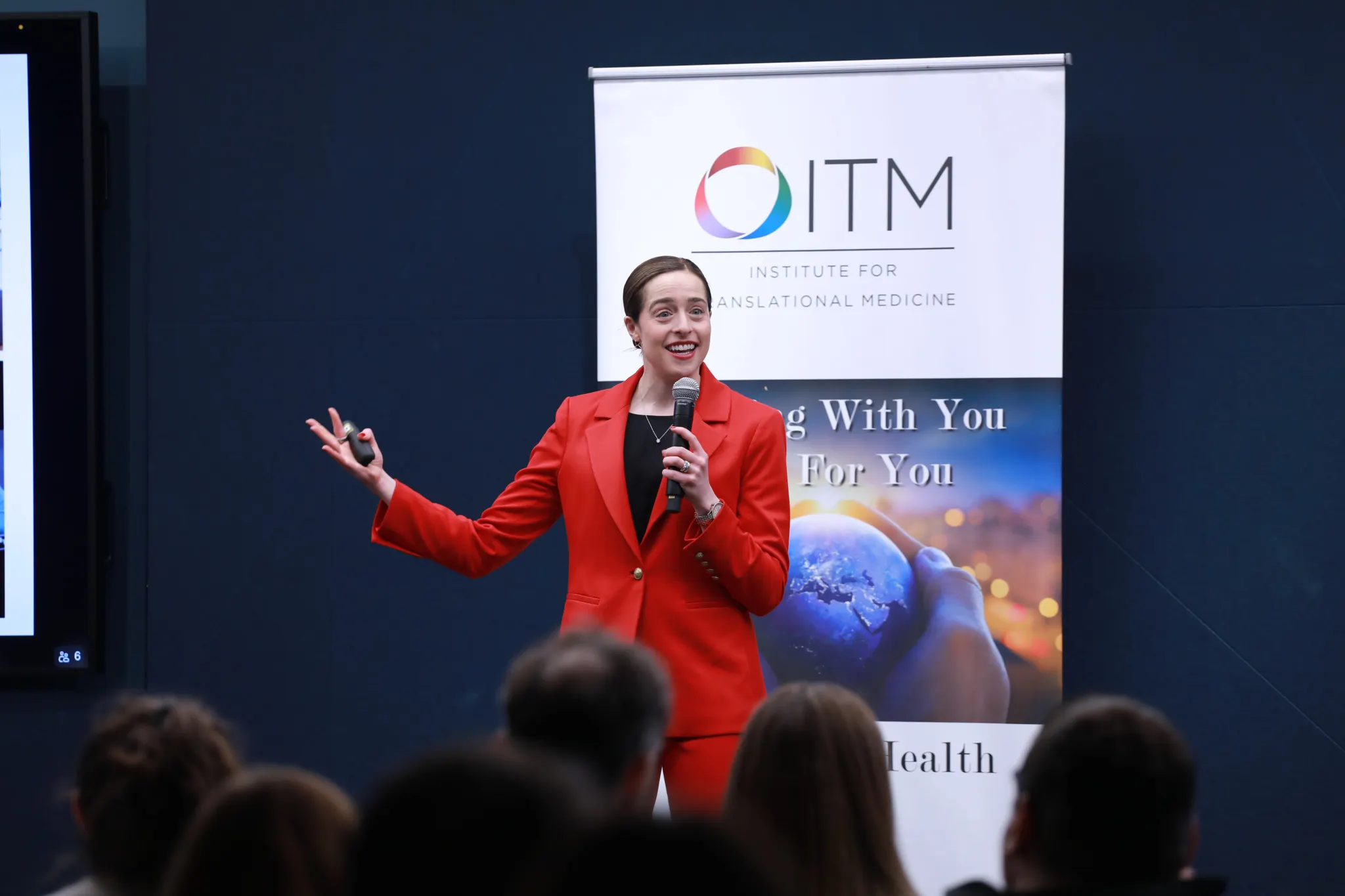
Institute for Translational Medicine (ITM) researchers came together with about 100 Chicagoland community members to spark connections and share stories behind innovate research supported by the ITM’s Pilot Awards program to propel creative science explorations – like new potential ways to diagnose and treat head and neck cancer, keep a hospital soap effective and not turbo charge bad bacteria, and treat blood clots and fight childhood cancer with a bubble technology.


Three researchers from the University of Chicago and RUSH presented their ITM-funded projects in an approachable, public-friendly way at a special ITM Grand Rounds event on March 20 at MATTER in the Merchandise Mart in downtown Chicago. Each researcher previously received $60,000 in seed funding to launch these early-stage ideas with the potential to transform health and medicine. 

Who here has known someone who’s been sick?” asked event MC Sara Serritella, ITM’s Director of Communications who teaches science communication at UChicago and coached the presenters. “Who here has known someone who’s died? And what would you have given to have a little bit more time with those people? Everything, right? Everything. Thanks to science and research, that’s where breakthroughs happen, where you can ideally have more time with the loved ones you care about most. That’s why we’re here doing what we do.”
ITM Event Highlights Breakthrough Science
Audience members connected with researchers and enjoyed a red-carpet reception with light bites and an open bar following the presentations.

“It was cool to see the discoveries that were being made in the science and how they were actually affecting the healthcare setting,” said attendee Christina Warner.

From Stickers to Saliva: Exploring New Ways to Diagnose and Treat Cancer

ITM-UChicago translational cancer researcher Evgeny Izumchenko, PhD, Assistant Professor of Medicine, kicked the presentations off with a talk about the major hurdles in treating head and neck cancer.

For the nearly 900,000 people worldwide who are diagnosed with head and neck cancer each year, the treatment can feel as grueling as the disease itself. Traditional chemotherapy and invasive surgeries can strip away a person’s ability to speak, swallow, or breathe. Izumchenko is leading research to catch this condition early and develop non-surgical treatments. 


“Many of the patients die because we don’t know yet how to treat those cancers well,” Izumchenko said. “And even the patients that are treated and cured, the effects of the therapy can be long-standing. We want to find ways to treat the patients in ways that will, first, cure them, and, second, will strip them from the side effects that the therapy that we are using now can actually cause.” 

One promising innovation he and his team created is a patch that can be placed directly on a tumor in the mouth to deliver medicine that kills the cancer. This approach could ensure the chemo stays where it’s needed instead of spreading throughout the body, causing harmful side effects. 

Izumchenko’s team is also working on a simple saliva test that could help dentists and doctors identify cancer earlier, when it’s far more treatable, and reduce unnecessary biopsies. 

Want to learn more? Connect with Evgeny at izumchen@bsd.uchicago.edu.

Keeping a Hospital Soap Effective at Protecting Patients

The audience next heard from ITM-RUSH researcher Rachel Medernach, MD, Assistant Professor in the Department of Internal Medicine. 

Medernach shared a story of a patient who developed a serious bloodstream infection while hospitalized for chemotherapy. Healthcare-associated infections affect 1 in 31 patients each day in the United States. They are especially dangerous for people with weakened immune systems or medical devices like IV lines, which can allow bacteria to enter the body.

A special antiseptic soap called chlorhexidine is a simple but powerful prevention tool. Studies show it can significantly reduce infections, including those caused by antibiotic-resistant bacteria, particularly for high-risk patients. 


In her research, Medernach investigated whether widespread use of the soap could lead to the bad bacteria becoming resistance over time and found that it didn’t, which is good news for patients and hospitals. 

“If I can prevent patients from getting these infections in the first place with something as easy as using a special soap for their baths, I’m all for it,” said Medernach.
Want to learn more? Connect with Rachel at rachel_l_medernach@rush.edu.

Could a Tiny Tornado Technology Treat Blood Clots and More?

ITM-UChicago’s Kenneth Bader, PhD, Associate Professor of Radiology, showed how physics and engineering can open new doors for treating disease. His work focuses on using powerful ultrasound waves to create tiny, fast-moving “bubbles” inside the body that can physically break apart harmful tissue, like blood clots, without surgery.
“It’s like we’re performing surgery, but not doing surgery,” Bader said, as bubbles floated throughout the room. “We don’t have to cut the patient open.”
This technology could offer a faster and safer treatment for blood clots, which kill 100,000 Americans each year. Bader’s early research already showed that combining his bubble technology with medication already used improved treatment of blood clots. His team is also exploring how this approach might help treat hard-to-tackle kid cancers by directly damaging tumor cells and even activating the body’s immune response.

Want to learn more? Connect with Ken at baderk@uchicago.edu.

About the Institute for Translational Medicine (ITM)

Chicago ITM
The Institute for Translational Medicine (ITM) helps you live your best life by making research breakthroughs happen and getting those discoveries into the real world to improve your health as soon as possible.
The ITM is part of a network of more than 50 CTSA Program-supported hubs across the country working to slash the time it takes to develop and share new treatments and health approaches. We work with you and for you to make participating in health research easy, so that together we improve health care for all.
Join the movement and learn more about how we help researchers, physicians, community members, industry, government organizations, and others. Visit us at chicagoitm.org and connect with us on Facebook, Twitter, Instagram, YouTube, and LinkedIn @ChicagoITM.

ITM Contact: Sara Serritella, Director of ITM Communications, serritella@uchicago.edu 

This project is supported by the National Center for Advancing Translational Sciences (NCATS) of the National Institutes of Health (NIH) that supports the Institute for Translational Medicine (ITM) through Grant Number UL1TR002389.

Want to be an ITM Insider? Tell us what you want to know and we'll send it direct to your Inbox.